

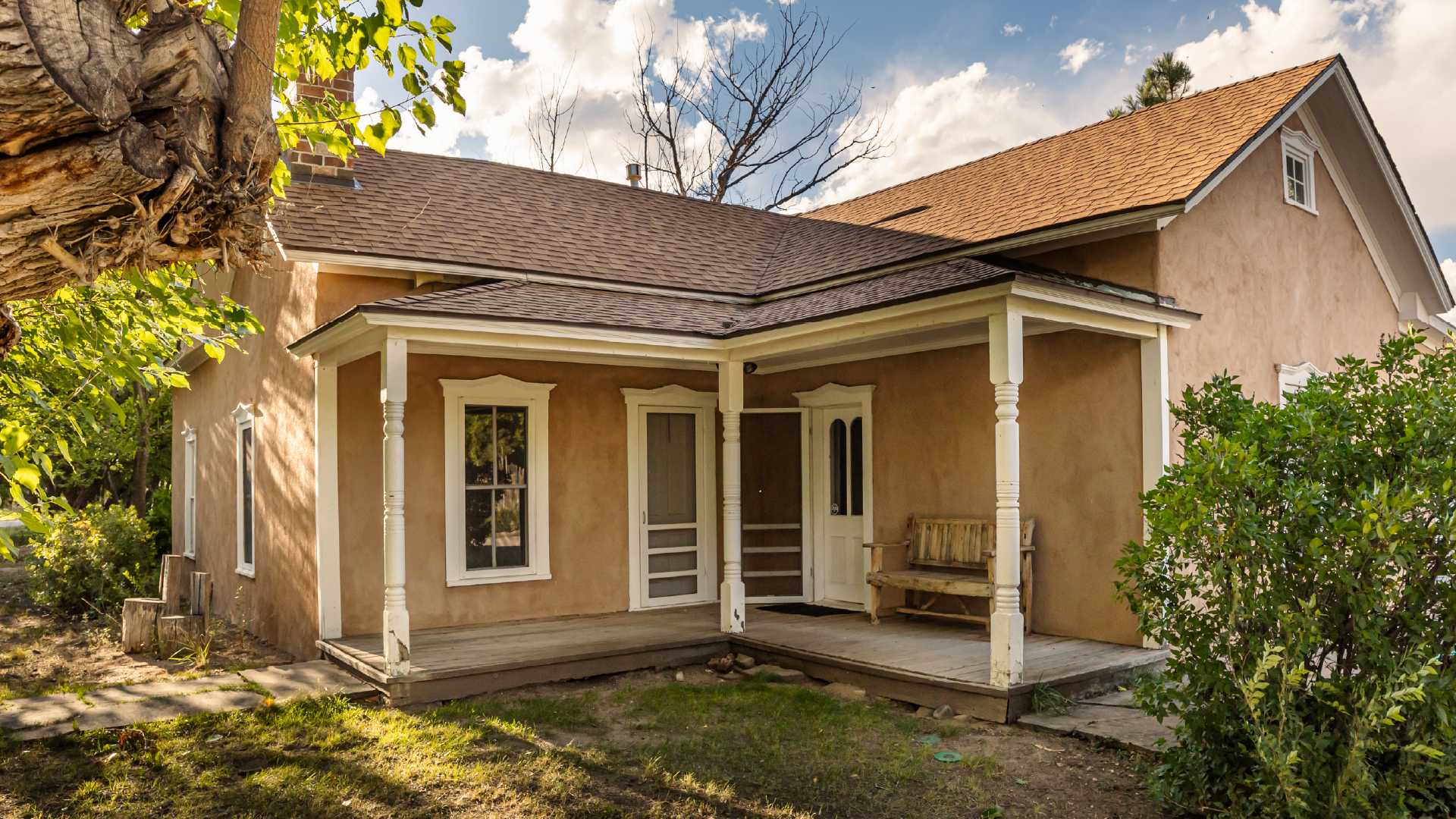
The Victorian cottage built in the late 1800s that Abel Lucero and his family lived in at Los Luceros Historic Site.
Tewa History
Sitting alongside Los Luceros Historic Site is the Pueblo site of Phiogeh Owingeh (The Place of the Flicker). It was here that the Tewa people lived for hundreds, if not thousands, of years before they left around the time of the second Spanish arrival in the 1690s.
The people of Phiogeh used the land of Los Luceros to hunt, farm, and gather water straight from the Rio Grande. The river then, not contained to one solitary line, spread wide across the floodplain Los Luceros sits in. Phiogeh’s people guided it, irrigating their crops, or creating islands from which to gather nutrient-rich soil. Phiogeh’s people left in the 1690s, some returning to Mesa Verde while others joined the nearby Pueblo of Ohkay Owingeh. Ohkay Owingeh now cares for Phiogeh’s site.
Spanish History
When the Spanish returned in the 1690s, with them was Sebastián Martín Serrano. Martín Serrano would gain a land grant of over 51,000 acres, including the land of Los Luceros Historic Site. Martín Serrano would make his mark on the property and on nearby communities, by contracting the building of the acequia madre. The 5-mile-long ditch, fed directly from the Rio Grande, is still used by farms and community members to this day.
Martín Serrano’s family inherited his land, splitting it up among the family members for years until a young descendant of Martín Serrano’s, Julian Lucero, decided to buy his cousin’s shares and piece much of the land back together under his ownership. Julian Lucero would lead a prosperous farm and orchard, with thousands of fruit trees. He was also a very well-to-do individual in his community. Julian Lucero is the namesake of the community and site of Los Luceros.
Early American History
In 1850, Julian Lucero married his daughter to an Irish immigrant named Elias Clark. Clark was the first Anglo owner of Los Luceros. He would keep up its orchards and farms, selling his goods in Santa Fe and local communities. He also held government positions, which brought further attention to the community of Los Luceros.
Clark’s time owning the property would be short-lived, as he died in 1860, likely of complications due to tuberculosis. His daughter Eliza and her husband, Luis Ortiz, inherited the site. Their ownership of Los Luceros saw its horizons broadened; further development of the orchards, the rebuilding of the 18th century capilla (or chapel), and the addition of a second story to the hacienda.
Around that same time, Abel and Ursula Lucero built the Victorian Cottage which now sits only a brief walk from the Visitor Center. They would be the last Lucero family to live on the property, being forced to leave due to foreclosure shortly before the Great Depression. The mulberry tree outside the home was planted by Abel Lucero, making it well over 100 years old.
Mary Wheelwright Restoration
None of Luis and Eliza Ortiz’s children chose to pursue ownership of the large farm. The site sat vacant for many years, after an elderly Luis Ortiz moved to Santa Fe. In the early 1920s, Mary Cabot Wheelwright purchased the hacienda and a small plot of land from Luis Ortiz. Upon arriving, Wheelwright renovated the large hacienda, as much of the building was crumbling.
Los Luceros would be the base from which she explored New Mexico and where she planned her museum, The Navajo House of Prayer, which would become The Wheelwright Museum in Santa Fe. Wheelwright and Hastíín Klah recorded chants, rites, and cultural knowledge of the Navajo people, to preserve the culture for generations to come.
Later Ownership and Restoration
Wheelwright would leave her home to her museum after she passed in 1958. The land was left to her friend and farm manager, Maria Chabot. Chabot was a farmer, writer, and passionate individual. She is usually best known for building Georgia O’Keeffe’s house in Abiquiu and for reinvigorating the Indian Market in Santa Fe, for which she was named a Santa Fe Living Treasure in 1996.
Chabot married in 1960, selling the land to the same family that purchased the hacienda from Wheelwright’s museum, Charles and Nina Collier. Their family enjoyed Los Luceros for many years, farming, planting many of the apple trees still in the orchard, and collecting Spanish Colonial art.
After Nina Collier passed in 1973, Charles chose to sell the property, starting a long line of short-lived owners. Malcolm Grimmer, a gallery owner and artist, owned the property from 1982-1986. Though his ownership was not long, he was able to get Los Luceros added to the National Register of Historic Places.
In 1988, Fred Segal purchased the property. He was best known for his fashionable clothing stores in California, including the self-named ‘Fred Segal.’ He built the River House but never had many solid plans for the property or historic buildings. Segal left the property in the early 1990s.
In 1999, Frank and Anne Cabot, very distant relations of Mary Wheelwright, purchased the property. At that point the hacienda was again in bad condition, and they worked tirelessly to bring it back to life. They chose to keep many of the same design choices as their cousin, to honor her. They were also responsible for building the new front entrance, visitor center complex, and converting the old corral into a walled garden.
State Ownership, Historic Site, and Hacienda Restoration
In 2008, the State of New Mexico purchased the Los Luceros property, but it would not be until 2019 that the 54th New Mexico Legislature designated Los Luceros as a New Mexico Historic Site.
In 2024, the site’s hacienda began being restored by the state, thanks to a grant funded by the National Park Service. The building received new plaster and paint outside, structure stabilization, and heaters were added to the building for the first time in its centuries-old history. Its accompanying outbuilding, the almacén (or storehouse), also received a new roof, plaster, and heating and air conditioning with the goal of using it for education and interpretation.