

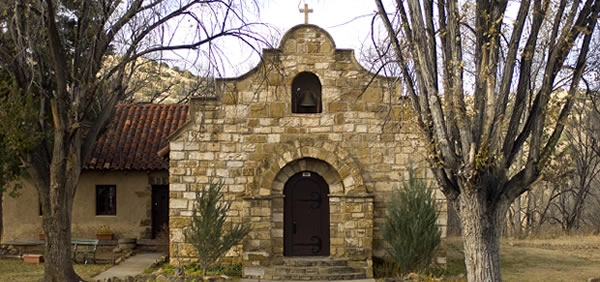
Fort Stanton historic chapel.
On March 19, 1855, three hundred soldiers from the 3rd U.S. Infantry Regiment began constructing Fort Stanton along the banks of the Rio Bonito. Located in a valley between the Capitán Mountains and the Sierra Blanca, known among the Mescalero Apache as zúuníidu, meaning "beautiful land," the future fort would lay in the heart of the tribe's territory.
The fort was the brainchild of Josecito, the leader of the Sierra Blanca band of the Mescalero Apache. He had first proposed the establishment of a military post two years earlier as part of a peace agreement with New Mexico Governor William Carr. The treaty, however, had since collapsed. The erection of the fort, initially envisioned as a place of trade and protection, was now an act of conquest. It marked the first time that outsiders had settled in the area since the Mescalero had made it their homeland around the turn of the sixteenth century. It also heralded the beginning of a complex relationship that shaped both the built environment of Fort Stanton and the various people who interacted with it.
The environment surrounding the fort and its characteristics ensured its long-term survival and continual renewal. The soldiers had received orders to build Fort Stanton out of the same material as every other fort in the territory: adobe. But for reasons that are elusive today, they failed to follow this command. The most likely cause for the troop's apparent insubordination was Fort Stanton's isolation. It was located over one hundred miles from any major settlement, including local tradesmen and expert Hispano adobe makers. The post's commander noted this problem in a letter to his superiors in Santa Fe when he complained about the lack of skilled craftsmen available. In the end, the soldiers constructed the fort out of sandstone that they quarried nearby. The post that emerged thus took on the unique features of zúuníidu.
A Fort Transformed
The decision to build Fort Stanton out of stone rather than adobe proved fateful. The fort subsequently survived multiple abandonments, arsons, and lootings during the Civil War and conflicts with the surrounding Apache peoples. After the U.S. military formally withdrew from Fort Stanton in 1896, its robustness and location in zúuníidu led to the U.S. Marine Hospital Service, later known as the U.S. Public Health Service, to reoccupy and repurpose the site into the first federal sanatorium in the United States. From 1899 to 1952, Fort Stanton treated thousands of U.S. Merchant Marine and Coast Guard sailors afflicted with tuberculosis and spearheaded research on the disease.
Its unique infrastructure and setting also led to the establishment of the first German, and later Japanese-American, internment camp in the United States during World War II (1941–1945). In 1953, the federal government transferred control of Fort Stanton to the New Mexico state government. Until 1966, it remained a medical facility dedicated to treating tuberculosis among a new cadre of primarily Navajo patients. Use of the site subsequently waned, but nevertheless continued into the twenty-first century. It served as a branch of the Los Lunas Hospital from 1966 to 1995. During the late 1990s and early 2000s, the site served as a low security women's prison and a drug rehabilitation center.
Fort Stanton's resilience and repeated reinvention have made it among the most historically and architecturally significant sites in New Mexico. It remains the most structurally intact Territorial-era military fort in New Mexico and its history is deeply intertwined with the nearby Mescalero Apache. The vast majority of the site's structures and surrounding landscape features, however, date from the federal and state hospital periods in the twentieth century. Consequently, Fort Stanton's built environment is a product of both military conflicts and the development of the modern public health service.
These events involved diverse groups of peoples who called Fort Stanton and zúuníidu their home. They included Mescalero Apache, U.S. soldiers and their wives, settlers, gunslingers and outlaws, doctors, nurses, merchant sailors, Civilian Conservation Corps workers, German and Japanese-American internees, and the Navajo. Many of these peoples contributed to the appearance of the site's built environment today. Fort Stanton's period of significance, as a result, spans from 1855 to 1966 and the site is crucial to understanding local, state, and national history during these years.
Explore Fort Stanton's History
The Mescalero Apache and Zúuníidu, 1400-1845
Fort Stanton lies at the center of the traditional homeland of the Mescalero Apache, a people notable for their resilience and adaptability. The ancestral Mescalero, along with other Apache groups and the Navajo, were part of a broad group of Athabascan-speaking peoples who migrated from present-day northwestern Canada into the Southwest. The date of their arrival, however, is uncertain. Some evidence suggests that Puebloan peoples encountered and displaced Apache groups from the Rio Grande Valley in the late thirteenth and early fourteenth centuries. Most scholars, however, believe that Athabascans first arrived in the Southwest around 1450.
When the Spanish first entered the region in the sixteenth century, the Apache and the Navajo were well entrenched around Puebloan settlements in the Rio Grande Valley and further west in present-day Arizona. These areas became known broadly as Apachería, the land of the Apache. Within Apachería, the Mescalero occupied the area around the Organ Mountains, Sierra Blanca, Sacramento Mountains, and Guadalupe Mountains, which would remain the core of their territory.
The Mescalero, like other Apache groups, were decentralized and matrilineal. When a couple married, the husband moved into his wife's camp. Camps usually consisted of four or five households, which included an older couple, their unmarried children, and the families of their married daughters. Every camp was under the leadership of a headman. Multiple camps, in turn, formed a local group under the leadership of a chief (nantan). United through kinship and culture, but nevertheless remaining autonomous under their chiefs, several groups together formed a tribe or band. The inability of U.S. officials to understand this social structure would later play a key role in the establishment of Fort Stanton.
When the Spanish first arrived in the sixteenth century, the Mescalero primarily were hunter-gatherers who used dogs to transport their goods. The Mescalero's range extended north from their mountainous strongholds in present-day southeastern New Mexico, where they hunted deer and elk, into the eastern portion of the Great Plains known as the Llano Estacado, where they hunted bison. They also collected agave hearts and roasted them in large pits. This activity led the Spanish to label them "Mescaleros" from the Spanish term "mescal" for the agave plant and the suffix "ero" meaning "person who makes." The roasted and dried agave heart was a sweet food that, along with animal hides, became important goods that the Mescalero traded with the Pueblo peoples. The Mescalero learned from the Pueblo Indians, in turn, how to grow maize, beans, and squash, which they grew along mountain streams and river valleys. As the largest river valley within the Mescalero's mountainous territory, zúuníidu was uniquely suited to these pursuits. It provided a safe and reliable place for the Mescalero to hunt, roast agave, and farm.
The Spanish Era
After the Spanish occupied the northern Rio Grande Valley in 1598 and established the Kingdom of New Mexico, they began to raid the Mescalero and other Apache groups for captives. Apache captives became an important commodity and the Spanish sent many to work in the silver mines of Nueva Viscaya in modern-day Chihuahua, Mexico. Around the middle of the seventeenth century, however, the Mescalero were among the earliest indigenous groups — and perhaps the first — in the Southwest to acquire and learn how to ride horses. The adoption of this European technology transformed the Mescalero into mounted hunters and warriors. They displaced non-Apache tribes in the southern Great Plains, in the process seizing large numbers of captives, dominating bison hunting, and gaining control of new fertile areas to farm. The Mescalero also began to raid Spanish and Pueblo settlements. In the 1670s, they forced the abandonment of the Spanish-allied Tompiro pueblos, known today as the Salinas Pueblo Missions. They also helped drive the Spanish from New Mexico by allying with Pueblo revolutionaries during the 1680 Pueblo Revolt.
Decline and Resilience
Mescalero power declined dramatically over the following century. In 1692, the Spanish reestablished their control in New Mexico and continued to wage war on the Apache. Around the same time, a new foe arrived in the region: the Comanche. The Comanche and their Ute allies waged a ruthless war against the Mescalero and other Apache groups, displacing them from the southern Great Plains by 1730 and taking large numbers as captives. The Comanche sold so many Apache captives to the Spanish that they eventually formed as much as fifteen percent of the Spanish population in New Mexico. The surviving Mescalero, in turn, retreated into their mountain strongholds from the Sierra Blanca to the Guadalupe Mountains. Cut off from the bison herds they previously relied on for food and trade and vulnerable to further Comanche and Spanish attacks, the Mescalero fell into poverty and hunger. Many nevertheless adapted and found ways to survive. Zúuníidu and other mountain valleys offered deer, nuts, berries, and most of all agave that provided them with sustenance.
In 1786, the Spanish and Comanche struck an alliance and coordinated their efforts against the Apache. They launched a series of campaigns during the 1790s that proved catastrophic for the Mescalero. The Spanish and the Comanche killed or captured 750 men, women, and children, which likely comprised the majority of the tribe. Among the surviving Mescalero, some chose to remain in the mountains and maintain their perilous autonomy. The majority relocated near El Paso and accepted Spanish suzerainty. In return for protection and rations, the Mescalero served the Spanish as guides against other Apache groups. The Spanish eventually allowed the Mescalero access to their mountainous homeland to hunt and in 1810 formally recognized the region from the Sierra Blanca to the Guadalupe Mountains as Mescalero territory.
Mexican independence in 1821 transformed conditions for the Mescalero. The Mexican government lacked sufficient resources to administer the northern frontier, which included providing rations to the Mescalero. As a result, the Mescalero absconded from El Paso and returned to the mountains. Armed with new cavalry tactics and geographic knowledge honed during their time as guides, Mescalero warriors, often accompanied by their wives, began to raid Mexican communities in Chihuahua and Sonora for captives and livestock. Mescalero raiders, along with other Apache and Comanche counterparts, forced the abandonment of settlements across northern Mexico. Mexican officials in Chihuahua and Sonora retaliated by offering rewards for Apache scalps.
During this period, New Mexicans and the Mescalero maintained peaceful relations. New Mexican governors sought to cultivate the Mescalero as a buffer against Texas, especially after the Texas-Santa Fe Expedition in 1841. New Mexico, in fact, became an important market for the goods that the Mescalero seized in their raids. New Mexican officials disobeyed orders from the Mexican government to bar the Mescalero from local trade fairs. Merchants from Santa Fe, in turn, periodically traveled into Mescalero territory to exchange weapons and tools for recently captured livestock. Based once again in their mountain strongholds, the Mescalero had reestablished their autonomy.
U.S. Expansion and the Establishment of Fort Stanton, 1846-1860
The outbreak of the Mexican-American War in 1846 and U.S. annexation of New Mexico in 1848 led to new challenges for the Mescalero. U.S. soldiers entered the territory and U.S. officials pledged to protect the new Hispano and Puebloan citizens from the surrounding independent indigenous groups. This policy took on greater urgency as a result of the Taos Rebellion in 1847, when concern over Navajo raids contributed to an uprising across northern New Mexico against the new U.S. administration. In the southwestern part of the territory, Anglo prospectors attempted to reoccupy the Santa Rita del Cobre Mines near present-day Silver City, which resulted in growing conflict with the Western Apache bands. U.S. officials worked to mollify these issues by striking peace treaties with the Navajo and various Western Apache groups. But these agreements failed. Anglos and Hispanos continued to encroach on Navajo and Western Apache lands. Various Apache bands and the Comanche, in response, continued to raid northern Mexico. Such attacks violated Article 11 of the Treaty of Guadalupe Hidalgo and mandated that the U.S. government respond to prevent them.
Beginning in the early 1850s, U.S. officials pursued a new policy of building forts to bring peace to the region. In 1851, the U.S. military built Fort Union near Las Vegas, Fort Conrad outside Socorro (replaced by Fort Craig in 1854), Fort Defiance along the present-day Arizona-New Mexico border, and Fort Webster next to the Santa Rita del Cobre Mines. The following year, they built Fort Massachusetts in the San Luis Valley in present-day southern Colorado. Ostensibly, U.S. soldiers stationed at these forts were tasked with policing not only the Navajo and Western Apache, but also preventing Anglos and Hispanos from interloping on indigenous land.
The Mescalero's relative isolation in the mountains of southeastern New Mexico initially spared them from U.S. military scrutiny. But the U.S. presence in the region soon unleashed Anglo and Hispano interlopers onto Mescalero lands. The 1848 California Gold Rush led to the establishment of the San Antonio–El Paso Road in 1849. Thousands of primarily Anglo migrants from Texas, as a result, began to flood through Mescalero territory near the Guadalupe Mountains on their way to the coast. The following year, Hispanos fleeing from U.S. rule in northern New Mexico established the town of Mesilla near Mescalero territory. Originally on the Mexican side of the border, Mesilla became part of the United States with the Gadsden Purchase in 1853. At around the same time, Hispano sheepherders and ciboleros (buffalo hunters) began to enter northern Mescalero territory from the Llano Estacado and established the small community of La Placita, which later became the town of Lincoln. These various encroachments diminished the amount of wild game to hunt and plants to gather for the Mescalero, undercutting their ability to provide sustenance for their communities.
The Mescalero were divided over how to respond to these growing pressures. The northern Mescalero bands, especially the Sierra Blanca band, occupied the most fertile region within Mescalero territory, which included zúuníidu. They sought to transition to greater agricultural production to make up for the loss of traditional foodstuffs. The southern Mescalero bands, especially those living in the Guadalupe and Davis Mountains, lived in a more arid environment that was less suitable for agriculture. They began to raid for livestock and other supplies from nearby settlements and travelers to survive.
The Establishment of Fort Stanton, 1851–1860
In the early 1850s, Chief Josecito, the leader of the Sierra Blanca band, attempted to establish an alliance with the United States that would diminish the power of the southern bands. In 1851 and 1852, he traveled to Santa Fe to negotiate with New Mexico Governor John C. Calhoun. On both occasions, he highlighted his band's efforts at farming and struck peace treaties with the governor. Josecito then returned to Santa Fe in June 1853 to renew the peace treaty with Calhoun's successor, Governor William Carr Lane.
By this point, Mescalero raiders were a growing U.S. concern and Josecito had to mollify Lane in order to renew the peace treaty. The leader of the Sierra Blanca band made clear that he lacked the power to control the behavior of other Mescalero bands, but he suggested that the U.S. establish a military post in Mescalero territory to ensure that "the bad people [i.e. raiders] which they have among them could be made to respect the treaty." Josecito likely also believed that a U.S. military presence would help protect the Mescalero from further outside encroachments. His words won the New Mexico governor over, who not only agreed to renew the peace treaty but also provide food and agricultural equipment for the Mescalero. The new U.S.–Mescalero alliance thus promised to transform zúuníidu into a valley dotted with farmland. It also laid the foundation for the establishment of Fort Stanton two years later.
Despite Josecito's efforts, the treaty soon collapsed. The U.S. Senate refused to ratify it, which left the program to supply the Mescalero bereft of funding. The New Mexico governor discontinued the program only a month after promising the resources to Josecito. In the meantime, southern Mescalero bands continued to raid around Socorro and El Paso. These attacks climaxed in August 1853, just two months after the treaty was agreed upon, when a group of Mescalero attacked an emigrant wagon train bound for California. The raiders killed ten settlers and drove off 150 head of stock. The event outraged U.S. officials who were either unwilling or unable to understand the decentralized political structure of the Mescalero. They held the Sierra Blanca Mescalero responsible for the attack and vowed to retaliate.
In 1854, the United States launched a series of punitive campaigns against the Mescalero in the Sierra Blanca. In January 1854, 150 soldiers from Fort Conrad journeyed into the Sierra Blanca to find the perpetrators of the massacre and obtain remuneration for the stolen goods. The Mescalero, however, succeeded in evading them. Six months later, a larger force of soldiers from both Fort Craig and Fort Fillmore returned to the Sierra Blanca but once again failed to find any Mescalero encampments. They did, however, scout the terrain and reported an excellent location for a military post in zúuníidu along the junction of the Rio Bonito and Rio Ruidoso.
The following year, U.S. military commanders launched a major campaign to subjugate the tribe. In January 1855, a combined force of 160 troops from Fort Fillmore and Fort Craig swept south from the Capitán Mountains through the Sierra Blanca and Sacramento Mountains. The campaign caught the Mescalero by surprise in their winter camps. Mescalero warriors launched hit-and-run attacks to slow down the U.S. troops long enough for their families to escape. In the resulting violence, at least fifteen Mescalero warriors died as well as two U.S. privates and Captain Henry Stanton, one of the commanding officers of the expedition. Most of the Mescalero managed to escape, but they were destitute because U.S. soldiers destroyed their camps and winter provisions.
The northern Mescalero fled to the Guadalupe Mountains and attempted to recuperate with their southern kinsman. But they lacked enough food and supplies to survive. In early March, Josecito was part of a Mescalero delegation that traveled to Fort Thorn to sue for peace. They negotiated with New Mexico Governor David Meriweather, who, upon seeing the wretched state of the Mescalero delegates, immediately authorized the dissemination of rations to the tribe. Despite this gesture of goodwill, Meriweather made clear that the Mescalero faced further U.S. reprisals unless they capitulated to his demands. In June 1855, Josecito and other Mescalero leaders signed a new treaty with the U.S. government. They agreed to live within the confines of a new twelve-mile by twelve-mile reservation in return for a monthly supply of rations. The Mescalero were forced to give up their autonomy in exchange for survival.
During the treaty negotiations, three hundred U.S. soldiers occupied zúuníidu and began constructing the military outpost that Josecito had first proposed two years earlier. But rather than a sign of friendship between the United States and the Mescalero as Josecito had envisioned, the fort was a manifestation of conquest. Named after the deceased Captain Stanton, the military post was located at the center of the new reservation. Fort Stanton henceforth served two primary purposes. First, its garrison launched scouts to corral the Mescalero onto the reservation and ensure that they remained there. Second, it served as a distribution center of rations for the Mescalero and a place where the Mescalero could trade, usually game, for goods. Over the next several months, hundreds of Mescalero began to converge on Fort Stanton and live within its surrounding confines.
The post that emerged took on the unique features of zúuníidu. Whereas other forts in New Mexico were constructed out of adobe, the soldiers utilized the materials found in the valley. They quarried nearby sandstone and harvested timber from the surrounding forests. From this material, they constructed nine buildings of undressed stone and shingled roofs around a single parade ground. Although they have all since undergone renovations, five of these nine buildings remain in some form today. These include the pair of officers' quarters (822 and 836), and barracks (827 and 830). Of note, building 836 currently comprises what were originally two separate officers' quarters. In addition, the original parade ground remains intact today.
Fort Stanton brought new peoples to the Mescalero's mountainous homeland. Anglo soldiers, many of them German and Irish immigrants, and their wives occupied the military post. Among these newcomers was Lydia Spencer Lane, the wife of an officer, who lived at Fort Stanton from 1856 to 1859 and later wrote about her experience there. She recorded that the garrison at Fort Stanton maintained peaceful, if not overtly friendly, relations with the surrounding Mescalero. She also noted that "Fort Stanton was a beautiful post, with the best quarters in the army at the time." In this sense, the U.S. soldiers and their families at Fort Stanton recognized, as the Mescalero had before them, the unique beauty of zúuníidu.
During these first years after Fort Stanton's construction, the Mescalero faced perilous conditions. Congress never ratified the June 1855 treaty and, as a result, the Mescalero lived for years under the illusion that they enjoyed a treaty status that did not exist. The presence of U.S. troops at Fort Stanton, moreover, attracted settlers to the area. The small community of La Placita grew at the edge of the reservation, which later became the town of Lincoln. Its predominately Hispano inhabitants supplied goods to the fort and competed with the Mescalero for access to the area's resources. At the same time, the Mescalero remained vulnerable to outsiders. In 1858, vigilantes killed groups of Mescalero peacefully encamped outside Fort Thorn and near Doña Ana. The U.S. government never held the murderers accountable. The U.S. government also failed to supply the Mescalero with adequate rations and equipment for farming. The Mescalero, confined to a reservation that was a fraction of the size of their original homeland, were unable to hunt enough game to make up for the food shortfall. Some members of the tribe fled south to the few remaining bands that refused to move into the reservation. The majority of the Mescalero, however, found ways to survive on the reservation. Most notably, they turned once again to gathering and roasting agave hearts.
The Civil War and Its Aftermath, 1861–1869
The outbreak of the Civil War in 1861 destabilized the tenuous conditions at Fort Stanton and the surrounding Mescalero reservation. During that spring and early summer, many of the soldiers stationed in New Mexico defected to the Confederacy. In late July, a Confederate force invaded southern New Mexico from west Texas. Within short order, they occupied Mesilla and forced the surrender of the entire garrison at nearby Fort Fillmore. With the support of the majority of the residents of Mesilla as well as in the mining community of Tucson, then located in southwestern New Mexico, the Confederates declared the establishment of the new Confederate State of Arizona. Union officials were so concerned about the situation that they briefly considered withdrawing all regular troops from New Mexico.
News of these events reached Fort Stanton several days later and caused panic among the garrison. The fort was designed to oversee the generally peaceful Mescalero and lacked any meaningful fortifications, let alone walls capable of withstanding artillery. Faced with the specter of fighting well-armed Confederate troops, the commanding officer of Fort Stanton ordered the garrison's immediate withdrawal to Fort Thorn. As they departed, the soldiers hastily set fire to Fort Stanton. They also invited the Mescalero and the inhabitants of Placita to loot what remained at the fort. Fort Stanton likely would have been destroyed if not for a rainstorm that extinguished the fire shortly after the garrison left.
For the Mescalero, the abandonment of Fort Stanton posed new challenges and opportunities. The withdrawal of U.S. forces brought a sudden end to the supply of rations and other goods that they had come to depend on for their survival. Yet, they found themselves liberated from their reservation and free to reestablish their autonomy. Many members of the tribe moved to expel nearby settlers and regain control over their traditional hunting and gathering grounds. Others returned to raiding for captives and livestock, focusing in particular on the wagon trains along the El Paso–San Antonio Road.
The newly disenthralled Mescalero quickly came into conflict with the Confederacy. Mescalero raiders annihilated a Confederate detachment from Fort Davis. They also disrupted the supply routes that the Confederates in southern New Mexico relied upon for food and equipment. Colonel John Baylor, the Confederate commanding officer and self-appointed Governor of Arizona, retaliated by issuing orders for his troops to exterminate the Apache. He mandated that they kill all Apache adults and sell their children as slaves. As part of these efforts, he dispatched a company of troops to occupy Fort Stanton in mid-August 1861.
The Confederates soon discovered that they had underestimated their foe. In early September 1861, Mescalero warriors ambushed and nearly wiped out an entire Confederate patrol outside Fort Stanton. A week later, the two groups fought at nearby Placita. The battle proved to be the last straw for the Confederates. They withdrew to Mesilla the following day and on their way out set fire to Fort Stanton once again. The Confederates' occupation of Fort Stanton lasted less than a month. In the meantime, Mescalero raiders continued to maraud Confederate supply lines, forcing Confederate leaders to devote valuable troops to defend against them. As a result, the Confederate invasion force that sought to conquer northern New Mexico in early 1862 was significantly smaller than it might otherwise have been. The Mescalero thus made a crucial, if indirect, contribution to the ultimate defeat of Confederate forces in New Mexico at Glorieta Pass in March 1862.
The Carson Campaign
Following the retreat of the Confederates back into Texas, Union officials turned their attention to the Mescalero. They were divided, however, on how to deal with the tribe. General James Carleton, the commander of Union forces in the territory, believed that the Mescalero had broken the 1855 treaty and ought to be severely punished. In October 1862, he ordered Lieutenant Colonel Christopher "Kit" Carson to lead five companies of the New Mexico Volunteers to reoccupy Fort Stanton and launch a ruthless campaign against the Mescalero. He told Carson:
"The Indians are to be soundly whipped without parleys or councils… All Indian men of the tribe are to be killed whenever and wherever you find them. The women and children will not be harmed, but you will take them prisoners, and feed them at Ft. Stanton until you receive instructions about them."
If the Mescalero wanted peace, Carleton also explained that their leaders had to go to Santa Fe to speak with him directly.
Dr. Michael Steck, the Superintendent of Indian Affairs for New Mexico and former Indian Agent for the Southern Apache, pleaded with Carleton to avoid violence. He argued that the Mescalero had been peaceful and devoted to farming as long as they had received government rations. He also noted that it would be cheaper to feed the tribe rather than fight them. Left unsaid was the fact that it was arguably the U.S. government and not the Mescalero who had broken the 1855 treaty. Congress, after all, had never formally ratified the treaty. In addition, the U.S. government had effectively abrogated the existing agreement when its soldiers had abandoned Fort Stanton and ceased to provide rations to the Mescalero.
Steck's efforts to dissuade Carleton from using force on the Mescalero failed. The general stood by his position and reasoned, "I think severity in the long run will be the most humane course that could be pursued toward these Indians." He also decided to move the Mescalero away from their homeland to a new reservation at Bosque Redondo in eastern New Mexico.
The campaign against the Mescalero began in October 1862. Carson and the New Mexico Volunteers reoccupied Fort Stanton and found the post in ruins. While the stone walls of the buildings and stables still stood, the fires had destroyed the ceilings and looters had stripped away the doors, windows, and anything else removable. Carson's primarily Hispano soldiers began to use adobe to make temporary repairs to the walls and ceilings. Some of their adobe repairs are still visible today inside Building 836.
In the meantime, Carleton dispatched cavalry units of California Volunteers and Graydon's Independent Company to annihilate or force the unconditional surrender of the Mescalero. The ensuing casualties included Manuelito, the most influential Mescalero chief. In late October, Manuelito and members of his band attempted to surrender to Captain James Graydon and his cavalry. However, Graydon and his troops, following Carleton's orders, attacked without warning and killed Manuelito along with five men and a woman. Afterward, Graydon learned that Manuelito was also attempting to follow Carleton's instructions to travel to Santa Fe to meet with the general. Such attacks led to the deaths of at least 301 members of the tribe.
The violence toward the Mescalero outraged Carson, who had previously served as the Indian Agent to the Jicarilla Apache. He thought the campaign was needlessly brutal and was dismayed at Graydon's attack on Manuelito. He wrote to Carleton describing it as "not fair and open" and demanded that the general return all horses and mules seized in the attack to Manuelito's band. Carson also disobeyed orders by thereafter allowing all Mescalero, including men, to find protection at Fort Stanton. Hundreds of the surviving members of the tribe subsequently fled to the post for sanctuary. Carson furthermore dispatched Cadete, who had replaced Manuelito as the most influential Mescalero leader, and four other chiefs under armed escort to ensure that they safely reached Santa Fe to negotiate an end to the hostilities.
The harsh treatment of the Mescalero continued to create dissent among the forces stationed at Fort Stanton. In early November, Dr. J.M. Whitlock, a personal friend of Carson who was at Fort Stanton serving as a surgeon for the New Mexico Volunteers, became infuriated at Graydon's cruelty towards the Mescalero. The exact event that triggered Whitlock is unclear and the stories are manifold, including drunken soldiers murdering Mescalero infants. Many of these purported sparks of the conflict are likely apocryphal, but what they all represent is senseless brutality inflicted on the Mescalero. Upon some kind of atrocity, Whitlock confronted Graydon and their exchange of words resulted in a duel. Whitlock mortally wounded Graydon in the contest. In one last act of depravity, Graydon's men shot and killed Whitlock in retaliation. Carson was away during the incident, but when he returned to the fort he was incensed. He had Graydon's Independent Company disbanded and arrested a handful of its members for murder. Graydon subsequently died from his wounds, but not before Carson had him dishonorably discharged.
Cadete and the other Mescalero leaders, in the meantime, arrived in Santa Fe and attempted to negotiate with Carleton. The general's terms were blunt. He told them that the Mescalero must go to Bosque Redondo or be treated as hostiles. Cadete, like Josecito before him, recognized that his people had little choice but to accept the U.S. government's stipulations. He told Carleton, "You have driven us from our last best stronghold, and we have no more heart. Do with us as may seem good to you, but do not forget that we are men and braves." He surrendered and agreed to uproot his people from their homeland.
Bosque Redondo
By spring 1863, nearly 500 Mescalero had relocated to Bosque Redondo. At this new reservation, the U.S. military expected the Mescalero to fully adopt an agricultural way of life. But conditions there were intolerable. The Mescalero discovered that the water at Bosque Redondo was alkaline and unfit to drink, wood was scarce, and they were exposed to Navajo raiders. Carleton's decision to begin resettling Navajo prisoners at Bosque Redondo in 1864 made a bad situation even worse for the Mescalero. The over 9,000 Navajo internees greatly outnumbered them and seized control of the limited amount of shelter and land fit for farming. Carleton, in turn, not only refused to allow the Mescalero to hunt, but he even barred them from roasting agave hearts. These conditions led to starvation and disease, ultimately causing the deaths of nearly one-third of the prisoners at the reservation.
By November 1865, the Mescalero could no longer endure life at Bosque Redondo. Cadete warned local army officers that his people would not stay on the reservation in its current state but offered to return if the U.S. government improved conditions there. A short time later, nearly the entire Mescalero tribe fled Bosque Redondo in the middle of the night. They then scattered, many returning to the Sierra Blanca, Sacramento, and Davis Mountains. Some took shelter among the Western Apache. A significant number fled into the Great Plains and joined their ancient enemies, the Comanche. Outside of an occasional raid, the Mescalero more or less disappeared from the oversight of U.S. authorities for the next five years.
In 1868, the U.S. government finally closed Bosque Redondo and the Navajo returned to a new reservation in their homeland. Viewed as a brutal failure, the experiment soured the public on further reservations in New Mexico. At the same time, the U.S. government became focused on Reconstruction and failed to formulate a meaningful Indian policy. The situation of the Mescalero drifted into limbo.
Despite the disappearance of most of the Mescalero, U.S. troops remained at Fort Stanton and searched for the few bands that lived covertly in the mountains. California and New Mexico Volunteers were stationed at the post until the 125th Colored Infantry relieved them at the end of 1866. Formed in Kentucky in 1865, most of the soldiers of the 125th Colored Infantry were slaves at the time of their enlistment. Expecting to fight Confederate forces closer to their homes, they were dismayed when they learned of their deployment to New Mexico. In St. Louis, some members of the unit attempted to mutiny, claiming that their officers "wanted [them] to follow the Devil." Most of the members of the unit, however, made the journey across the Santa Fe Trail. A number of their wives accompanied them on the trip. At Fort Stanton, the Black soldiers went on patrols and made repairs to the still dilapidated fort while their wives worked as cooks and laundresses. The 125th Colored Infantry stayed at Fort Stanton until the end of 1867, when they journeyed back to Kentucky. A handful of its members, however, signed up for the Ninth and Tenth Cavalry Regiments and likely returned to the Southwest, and potentially Fort Stanton, in the following decade as Buffalo Soldiers.
As the Civil War came to an end, an influx of Anglo and Hispano settlers arrived in the area. Taking advantage of the newly vacated land and the market to supply goods to Fort Stanton, they concentrated in La Placita and renamed the town Lincoln after the recently martyred president. Among them were two former commanders of Fort Stanton, Emil Fritz and Lawrence Murphy. They became sutlers to Fort Stanton and established a trading post on its grounds called the Murphy Company. They soon expanded their business by building a saloon on the outskirts of Fort Stanton as well as a store in Lincoln known colloquially as the Big House. Through their control over supplying Fort Stanton, they became the most powerful figures in the region. Another notable settler was Saturnino Baca, who had served under Carson as a captain in the New Mexico Volunteers. In 1869, Baca introduced the bill to the Territorial Legislature that established Lincoln County. By this point, the community around Fort Stanton had become a burgeoning center of cattle ranching and mineral prospecting.
The Apache and Lincoln County Wars, 1870-1896
The Peace Policy and Reservation Life, 1869–1878
Under the post-Civil War administration of President Ulysses S. Grant (1869–1877), the U.S. government developed a new Indian policy. Grant denounced the U.S. government's longstanding treatment of the nation's indigenous inhabitants as "one of embarrassment, and expense, and has been attended with continuous robberies, murders, and wars." He promised a series of reforms emphasizing cultural assimilation rather than physical destruction, which became known as the Peace Policy. These reforms included devoting U.S. resources to peacefully moving Native Americans onto reservations as well as promoting farming and Christianity among them. The new measures led to the appointment of Lieutenant A.G. Hennissee as the first Mescalero Indian Agent since the start of the Civil War. Hennissee began to reach out to the few isolated Mescalero bands in the Sierra Blanca, promising protection, land, and even a school if they returned to the vicinity around Fort Stanton.
The Mescalero began to come back to the Fort Stanton area in large numbers in 1870. Hennissee convinced Chief José de la Paz and twenty-seven members of his band to resettle around the post at the start of the year. Once there, they began to grow maize and other crops to sell to the fort. Word of their decent treatment spread among the Mescalero diaspora. Cadete, who had been living in the Great Plains with the Comanche, crossed the Llano Estacado with his followers later that summer. By the following year, over 830 Mescalero had returned to their homeland around Fort Stanton.
Despite Hennissee's promises, the Mescalero faced conditions that were once again perilous. As part of the Peace Policy's reforms, the U.S. government declared in 1871 that indigenous tribes were no longer independent nations but "wards" of the state. The Mescalero, as a result, were ordered to live within the confines of an unofficial reservation around Fort Stanton as they waited for the U.S. government to establish a formal one and provide promised supplies. In the meantime, the U.S. government pursued "Peace by Force" against any tribes that refused to adhere to the new Peace Policy. As part of this strategy, the U.S. military launched campaigns against Apache groups who protested moving onto a reservation and interned them with the Mescalero. In 1872, 350 Lipans from Texas and 310 Chiricahua from Arizona lived among the Mescalero before being resettled on their own reservations later that year. The Lipans and Chiricahua strained the limited resources available among the Mescalero. But this brief period together led to the establishment of lasting social bonds that subsequently shaped U.S.–Apache relations and ultimately united the three groups.
In 1873, the U.S. government finally established a new reservation for the Mescalero. In comparison to their pre-Civil War confines, the new reservation was located further south and west. Fort Stanton, once located at the center of the Mescalero reservation, was now pushed to its northeastern margins. These changes reflected the influx of Anglo settlers to the area and their prioritization, especially around Lincoln. The newcomers gained access to the Rio Bonito and much of zúuníidu, which comprised the best lands for ranching and farming. The Mescalero, on the other hand, received the less-fertile lands in the Sierra Blanca and Sacramento Mountains.
The Mescalero came into conflict with nearby settlers almost immediately, usually over livestock and whiskey. Ranchers repeatedly accused the Mescalero of stealing their horses and cattle. These accusations were usually false. The Mescalero often received the blame for the work of Anglo cattle-rustlers and horse thieves, or when nearby stock accidentally wandered onto their reservation. But some members of the tribe did engage in livestock theft, often at the behest of other settlers who sold them whiskey. Mescalero leaders tried and failed to stop this destructive trade. In 1872, Cadete traveled to Mesilla to testify against selling whiskey on Indian lands. On the journey, however, he was waylaid and killed, most likely by whiskey traders.
The perception among ranchers that Mescalero stole their livestock led them to appeal to the troops at Fort Stanton to return the stolen goods. Their pleas led to sorties in which soldiers arbitrarily arrested Mescalero leaders to compel them to give up alleged offenders and their plundered livestock. Such encounters occasionally led to violence. In 1873, soldiers surprised a Mescalero encampment and opened fire when frightened Mescalero attempted to flee, killing seven men, women, and children. On other occasions, startled Mescalero bands abandoned their possessions leaving them destitute.
The Mescalero also had to contend with outlaws. In 1874 and 1875, Anglo gangs attacked several Mescalero encampments, killing several women and children, and stealing their horses. The soldiers at Fort Stanton, as a result, increasingly shifted their patrols to hunting down groups of Anglo criminals and troublemakers. But conditions remained so unsafe that Cadete's successors, Estrella and Peso, avoided traveling to Fort Stanton as much as possible. Capping off these calamities and adding to the state of fear, the influx of settlers brought disease to the area. In 1876, smallpox broke out in Lincoln and spread to the Mescalero. The epidemic killed around one quarter of the tribe.
The reestablishment of the Mescalero reservation coincided with Fort Stanton's renovation and expansion. In 1870, stone masons began major repairs and rebuilt a number of structures that had remained in ruins since the Civil War, most notably the barracks. Over the next ten years, the U.S. military added a host of new buildings to Fort Stanton. The old commanding officer's quarters was torn down and replaced with a new one. Also added to the parade ground was a guard house and adjutant's office. To the east of the parade ground, four laundress quarters were built as well as a new stables. These new structures were similar to the fort's original structures from the 1850s. They were constructed out of the same material, notably nearby quarried sandstone and harvested timber from the surrounding forests, and featured the same undressed stone walls and shingled roofs. These additions transformed Fort Stanton from a frontier outpost into a significant settlement.
Fort Stanton's expansion and the reestablishment of the Mescalero reservation bolstered its economic importance to the settlers based in Lincoln. Federal contracts to furnish them with supplies became the primary markets for most of the agricultural and livestock goods the settlers produced. The Murphy Company, founded by the former post commanders Murphy and Fritz, developed a local monopoly on provisioning the fort and the reservation. Fritz died in 1874 and Murphy, whose health was deteriorating, promoted a young clerk named James Dolan to become his new partner. Together Murphy and Dolan wielded their market control to set artificially low prices on crops and beef to force local settlers into debt. This economic control allowed the business partners to exert their authority over the area's farmers and ranchers or, conversely, force them into bankruptcy to seize their assets. While such measures caused Murphy and Dolan to become the dominant figures in Lincoln, they also generated popular disdain within the community.
The Lincoln County War, 1876–1878
In 1876, a new group emerged that attempted to break the Murphy Company's local monopoly. John Tunstall, a recent migrant to the area, and Alexander McSween, a local lawyer, opened a general store in Lincoln with the financial backing of the cattle magnate John Chisum. Business competition between the Murphy-Dolan and Tunstall-McSween factions overlapped with competing claims to Fritz's insurance policy. Murphy demanded proceeds from the policy to cover debts that Fritz allegedly owed him. McSween, in turn, represented Fritz's brother and sister, who were the inheritors of Murphy's former partner's estate. Tensions boiled over in January 1878, when Murphy dispatched Sheriff William Brady to Tunstall's Ranch, ostensibly to seize cattle as restitution for the amount owed from Fritz's insurance policy. Brady and his deputies instead killed Tunstall.
Tunstall's murder unleashed mayhem in Lincoln. Local officials sympathetic to the Tunstall-McSween faction issued warrants for Brady and his men's arrest. They also deputized the armed members of the Tunstall-McSween faction known as the Regulators, which included William "Billy the Kid" Bonney, to help execute the warrants. A group of Regulators subsequently hunted down and killed several members of the Murphy-Dolan faction. Local law enforcement, as a result, devolved into acts of vigilante justice among the two factions.
In March 1878, Governor Samuel Beach Axtell traveled to Fort Stanton to survey the trouble. Axtell, however, was not a neutral party. He was a close associate of the small group of powerbrokers known as the Santa Fe Ring that dominated the region's politics. At the time of Axtell's arrival, Murphy and Dolan had already developed strong financial ties with the Santa Fe Ring. They had borrowed more than $20,000 from the First National Bank of Santa Fe, which was owned and operated by Stephen Elkins and Thomas Catron, two of the leading figures of the Santa Fe Ring. Axtell and his associates thus had a financial interest in maintaining the Murphy Company's local monopoly. The governor consequently issued several decrees that favored the Murphy-Dolan faction. He fired the local officials that had issued the warrants against Sheriff Brady and his men, in effect granting the Murphy-Dolan faction control over local law enforcement. The governor also ordered the troops stationed at Fort Stanton to assist Sheriff Brady and his deputies in arresting members of the Tunstall-McSween faction.
The troops stationed at Fort Stanton were Buffalo Soldiers of the Ninth Cavalry under the command of Colonel Nathan Dudley. Deployed in New Mexico since 1875, the Ninth Cavalry's primary focus was to ensure that the Apache remained on their reservations. Axtell's command, however, forced them to intervene in civil matters. Dudley led his Buffalo Soldiers at Fort Stanton to help Sheriff Brady execute warrants of arrest for members of the Tunstall-McSween faction, particularly the Regulators.
Governor Axtell's unequal attempts to quell the violence failed. In April, the Regulators killed Sheriff Brady and one of his deputies on the main street in Lincoln. Over the next month, the two factions fought each other in a series of gunbattles. The violence spilled over onto the Mescalero reservation when the Regulators killed an affiliate of the Murphy-Dolan faction at Blazer's Ranch, now the town of Mescalero. In May, Axtell returned to the area and appointed George W. Peppin, one of Brady's deputies, as the new sheriff. He also once again ordered Dudley to assist local law enforcement against the Tunstall-McSween faction. At this point, the federal government stepped in. The commander of Fort Stanton received orders from the Department of War that he was no longer allowed to use his troops to help local law enforcement.
In July, the Lincoln County War reached its climax. The two factions fortified their respective stores and battled each other in the streets of the town. Sheriff Peppin appealed to the troops at Fort Stanton for assistance, claiming that innocent civilians were "being persecuted by a lawless mob." Dudley dispatched several of his soldiers to survey the situation and members of the Tunstall-McSween faction allegedly fired at one of the Buffalo Soldiers. Dudley, despite his orders to not intervene in the conflict, led his troops into Lincoln and brought with them a howitzer and a Gatling gun. While Dudley's troops focused on rescuing citizens trapped in the crossfire, they also pointed their cannons at the positions of the Tunstall-McSween faction. Many Regulators fled, which allowed members of the Murphy-Dolan faction to set fire to McSween's house. They killed McSween and several of his supporters when they attempted to escape the flames. The death of McSween, in which the soldiers at Fort Stanton played a crucial if indirect role, at last brought the conflict to a close.
The Lincoln County War ended with no winners. Murphy died shortly before the final Battle of Lincoln. Dolan declared bankruptcy soon thereafter and spent the rest of his life suffering from alcoholism. The surviving Regulators became fugitives and outlaws. Military authorities subsequently relieved Dudley of his command and he spent the next year in military and civilian trials. The courts eventually concluded that Dudley had not disobeyed orders and exonerated him of any responsibility for the violence. Despite Dudley's exoneration, the government indirectly denounced the events in Lincoln with the passage of the Posse Comitatus Act of 1878, which prevented the use of federal troops for domestic law enforcement.
The Apache Wars and Fort Stanton's Decline, 1878–1896
The end of the Lincoln County War coincided with growing unrest among the Apache. In 1878, the U.S. government ordered Chiricahua Apache bands living in Warm Springs, Arizona to relocate to a new reservation at San Carlos. Many instead chose to flee under the leadership of chiefs Victorio and Nana. Victorio and his followers initially fled to Mexico, but Nana and his band sought refuge among the Mescalero. Over the next year, the Chiricahua negotiated for an alternative to San Carlos until the U.S. government finally agreed that they could resettle at the Mescalero reservation. After the agreement, Victorio surrendered and moved to the area with his followers. By the summer of 1879, there were nearly 150 Chiricahua Apache living on the Mescalero reservation, with more on their way from San Carlos.
The Chiricahua did not remain among the Mescalero for long. Authorities in Grant County issued warrants charging Victorio with murder and livestock theft. Officials in the Bureau of Indian Affairs considered expunging the indictments to avoid further unrest among the Apache. But Victorio learned of the charges before they could make a decision and fled in July 1879. Around 250 Mescalero under the leadership of chief Caballero who were fed up with the conditions on their own reservation joined Victorio along with all the Chiricahua. This mixed Apache force spent the next year and a half raiding across southern New Mexico and northern Mexico.
The U.S. military responded to the Apache insurrection by deploying the Ninth Cavalry and Tenth Cavalry in a massive dragnet across southern New Mexico and west Texas. The Black cavalrymen chased Victorio and his followers across the southwest, but to little avail. Their horses were generally lower quality than those of the Apache and could not keep up. Victorio recognized this weakness and intentionally led the Buffalo Soldiers on long treks to force their mounts to go lame. Due to this strategy, the Ninth Cavalry began to suffer from an acute shortage of serviceable horses.
Colonel Edward Hatch, the commander of the New Mexico Military District and commanding officer of the Ninth Cavalry, blamed the Mescalero that had remained on their reservation for Victorio's success. Despite having little evidence, Hatch suspected that the Mescalero were clandestinely supplying the rebel Apache with weapons and horses. In April 1880, Hatch ordered three battalions of the Ninth Cavalry from Fort Stanton and Fort Bliss to enter the Mescalero reservation and disarm its inhabitants. The sudden emergence of large numbers of troops, however, frightened the Mescalero and caused many to flee. Perceiving them as hostile, the soldiers opened fire and killed fourteen people. The soldiers also seized all the fugitives' horses and mules, likely to replenish their own dwindling supply of mounts.
Victorio and his followers subsequently fled to Chihuahua. But they remained fugitives with the Mexican army on their heels. In August 1880, the Mescalero under Caballero tried to return home, but Victorio killed the Mescalero chief and forced the rest of the Mescalero to remain. This situation did not last long. In October, Mexican troops ambushed the Apache and killed Victorio. Most of the Mescalero, however, were fortuitously away from the camp hunting. Some then returned home while others joined with another group of survivors led by Chiricahua chief Nana. This latter group crossed back into the United States and continued to raid across New Mexico and Arizona until finally surrendering to U.S. forces in 1883.
The death of Victorio altered conditions on the Mescalero reservation. U.S. troops, who had been occupying the reservation since the brutal disarmament operation, finally withdrew and returned to Fort Stanton and Fort Bliss. Many of the surviving 580 Mescalero blamed the recent turmoil and violence on the rebel Apache. Consequently, when a group of Chiricahua under the leadership of Geronimo, Nana, and Naiche broke out of San Carlos in 1885, no dissident Mescalero joined them. Instead, roughly half of the Mescalero volunteered as U.S. Army Indian Scouts. They served alongside the Fourth Cavalry, who had replaced the Ninth Cavalry in 1881. The Mescalero scouts helped General Crook to track down and capture Geronimo, Nana, and Naiche in 1886, marking the final chapter of the Apache Wars.
The region's pacification diminished the military significance of Fort Stanton. The soldiers stationed at the post continued to conduct patrols, but they were little more than war games. Soldiers chased other soldiers pretending to be raiding parties across the desert. Among the participants of such exercises was a recent West Point graduate, Lieutenant John J. Pershing. The future commander of the Pancho Villa Expedition (1916–1917) and American Expeditionary Force (1917–1920) later wrote glowingly of his time at Fort Stanton. He claimed that he "lived like a king," spending much of his free time hunting and fishing. Like so many others before and after him, Pershing enjoyed his time in zúuníidu.
Fort Stanton's built environment continued to develop during the late 1880s and 1890s. A new officers' quarters was built on the parade ground as well as the original grain silos near the stables. These silos stored crops from the new farmland established on the north side of the Rio Bonito. Most of the changes, however, emphasized domestic comfort rather than frontier utility. Porches, wings, and new windows were added to the officers' quarters, barracks, guard house, and adjutant's office. Indoor plumbing and even an ice machine were finally installed in the early 1890s.
Fort Stanton's beautification coincided with its military decline. In 1890, the U.S. government declared the frontier formally closed. By this point, the U.S. military had abandoned nearly all the military forts in New Mexico. Fort Stanton remained in operation in large part due to its economic importance to the inhabitants of Lincoln. Nevertheless, its garrison withered. By 1893, only fifteen men were stationed at Fort Stanton. They no longer even conducted simulated patrols, but instead focused on maintaining and guarding the fort. Finally, the U.S. military officially abandoned Fort Stanton in 1896. Fort Stanton's role as a frontier military outpost had come to an end.
The Establishment of Fort Stanton Hospital, 1897-1929
The culmination of U.S. continental expansion and settlement happened at the same time as the emergence of industrialization, urbanization, and the spread of disease, the confluence of which ultimately led to Fort Stanton's repurposing. Between 1850 and 1910, the average manufacturing plant multiplied its capital 39 times, boosted the value of its output more than 19 times, and increased its number of employees sevenfold. Industrialization fueled urbanization, as most of the factories were located in cities. In the same 60-year window that saw the unprecedented growth of manufacturing, the number of cities surged from 939 to 2,262 and the number of urban centers with populations over 100,000 more than doubled from nineteen to fifty. By 1920, the majority of Americans lived in towns and cities for the first time in the nation's history.
The country's rapid urbanization led to a massive shortage of affordable housing and unsanitary living conditions. According to some estimates, over half the population of New York City lived in slums in the late nineteenth century. These inhabitants endured substandard housing, poor nutrition, and inadequate sanitation. Consequently, cities emerged as epicenters of disease in the United States. Typhoid, cholera, polio, influenza, and most of all tuberculosis flourished in urban environments. At the turn of the twentieth century, tuberculosis was the third leading cause of death in the United States and accounted for nearly half of the deaths of people between the ages of fifteen and thirty-five. The prevalence of diseases in cities led to notable divergences in the life expectancy between rural dwellers and urbanites. In 1900, rural white males lived on average ten years longer than their urban counterparts.
The proliferation of tuberculosis occurred as the field of modern medicine was taking shape, and the disease became a major focus of medical research. In 1882, German physician Robert Koch first identified the bacteria that caused tuberculosis, tubercle bacillus. In 1895, researchers developed the first x-rays, which became a vital tool to diagnose the disease. To treat tuberculosis, medical practitioners established medical facilities called sanatoria that sought to provide ideal conditions to arrest the disease in patients. Such facilities emphasized rest to permit healing, exercise to provide strength, and rich food such as eggs and dairy products to restore wasted tissues. In the United States, the modern sanatorium movement began in 1885 with the establishment of the Adirondack Cottage Sanitarium in upstate New York. By the turn of the century, there were 96 sanatoria in the United States, mostly concentrated on the East Coast.
Convalescing in a salubrious environment emerged as an important treatment for tuberculosis. Dr. Walter Wyman, who became the third U.S. Surgeon General in 1891, was among the leading researchers on the benefits of climate to treat the disease. He ran the U.S. Marine Hospital Service, the forerunner to the U.S. Public Health Service, which was responsible for providing medical care for the sailors serving in the U.S. Merchant Marine and U.S. Revenue Cutter Service, later known as the Coast Guard. The cold, damp, and cramped living conditions aboard ships resembled the living conditions in cities, and tuberculosis was a major problem within these services. In 1895, Dr. Wyman published the first study arguing that the arid and mild climate of the Southwest was an ideal location to treat tuberculosis patients.
Fort Stanton Hospital, 1899–1929
Dr. Wyman utilized his research to successfully lobby to establish a federal sanatorium in the Southwest. In 1898, he dispatched Dr. J.O. Cobb to investigate abandoned forts in Arizona and New Mexico as possible sites for a medical facility. After visiting Fort Stanton, Cobb described it as "an ideal site" as a result of "its undoubted advantage of climate, a generous water supply, a large reservation, and substantial stone buildings." Fort Stanton and the landscape of zúuníidu thus offered a uniquely salubrious environment that stood in stark contrast to the unhealthy conditions found in most of the country's cities.
In 1899, President William McKinley transferred control of Fort Stanton to the U.S. Marine Hospital Service. The site was rechristened the Marine Hospital Service Sanatorium, but became known colloquially as Fort Stanton Hospital. As the first federal sanatorium in the United States, Fort Stanton Hospital was designed not only to provide care for Merchant Marine and Revenue Cutter Service sailors afflicted with tuberculosis, but also to conduct research on the benefits of climate to treat the disease. Techniques developed at the site thus promised to influence the treatment of tuberculosis patients nationwide.
Dr. Cobb became the first medical director of Fort Stanton Hospital and oversaw the transformation of the former military fort into a modern sanatorium. The site at the time of his arrival was in disrepair. One of his colleagues later wrote, "The buildings were in such a dilapidated condition as to be absolutely uninhabitable when the station was established [in 1899]." Cobb spent six months updating Fort Stanton Hospital to prepare it for patients. He launched a series of remodels, which included painting the undressed sandstone buildings white. He renovated the officers' quarters in order to house the early medical staff, including an east addition and a second floor. He converted two barracks into wards capable of each holding 60 patients. He transformed the remaining barrack into a dining hall, which included adding a kitchen. The gambrel roofs and Palladian windows today date from Cobb's renovations. Cobb also equipped the old hospital on the southwest corner of the parade ground with advanced equipment to treat tuberculosis, including a bacteriological laboratory, x-ray equipment, and surgical instruments. Finally, he contracted for a modern steam laundry, a one-ton ice plant, and a power plant. Fort Stanton Hospital emerged from the overhaul as a state-of-the-art medical facility.
The first patient arrived at Fort Stanton Hospital at the end of 1899. The facility thereafter maintained a population of around 200 patients. The patients reflected the heterogeneous composition of sailors, comprising an assortment of nationalities and ethnicities. They received treatment designed to halt the disease and restore them to working capacity. It consisted of lots of food, rest or graduated exercise, and as much exposure to open air as possible. The medical staff added to the sanatorium's population. It consisted of six surgeons, five nurses, and 25 additional attendants. Most of the staff were themselves afflicted with tuberculosis. Cobb and a number of other physicians had arrested cases of the disease. The architect J. Ross Thomas, who oversaw much of the fort's early renovations, was a third-stage consumptive. The patients and the staff were thus engaged in a shared enterprise to improve their conditions within the healthful atmosphere of zúuníidu.
Tents became one of the key early innovations at Fort Stanton Hospital. Initially, patients slept in the wards with their windows and doors open to get as much fresh air as possible. One enterprising patient, however, bought a tent and began to sleep outdoors. This practice intrigued Cobb and his staff and they provided several tents to patients as an experiment. The results were so impressive that Dr. Paul M. Carrington, who succeeded Cobb as medical director in 1901, rapidly expanded the tent program. He worked with Thomas, the architect, to design tents specifically tailored to the needs of tuberculosis patients. They began to construct the tents out of a mixture of wood and canvas to emphasize ventilation. Carrington subsequently described the tents as "a nearly perfect consumptive building." By 1912, two-thirds of the patients lived in 87 tent houses. The majority of these structures were located on the hill south of the parade ground. There was also a smaller, segregated tent area for Black patients to the southwest near the current nurses' quarters.
During his tenure as Fort Stanton Hospital's medical director, Carrington oversaw other changes to the site. Between 1901 and 1912, he converted the parade ground into an exercise lawn where patients played tennis and croquet. South of the tent terrace, he built a golf course. He also renovated the adjutant's office, converting part into a library and adding a second floor. After the old army hospital burned down in 1905, Carrington requested a new hospital and later a new residence for female nurses. While funding for these projects never materialized, Carrington's entreaties provided the basis for the later construction of a power plant in 1935 and a hospital in 1936.
During the early years of the twentieth century, the Mescalero continued to evolve and adapt. In 1902, the federal government declared the tribe self-sufficient and ended the ration program, even though the Mescalero lived in intense poverty. The continually resilient Mescalero, in response, pivoted into forestry and the cattle industries. They were successful enough in the venture that they even accumulated enough resources to offer refuge to other Apache that they had developed bonds with during the Apache Wars. In 1905, they welcomed 37 Lipan, which were all that remained of the once powerful band. In 1913, the Mescalero received 187 Chiricahua, who had been living as prisoners of war at Fort Sill in Oklahoma. In the meantime, the Bureau of Indian Affairs contracted with the physicians at Fort Stanton Hospital to provide the Mescalero with medical care. Members of the tribe continued to visit and interact with the fort until the establishment of the Mescalero Indian Hospital in 1916. Fort Stanton thus became a place of care rather than oppression for the Mescalero, perhaps finally embodying what Josecito had first envisioned for the site in 1853.
A National Model
The treatment and research conducted at Fort Stanton Hospital had national significance. The physicians at the facility published articles and presented papers highlighting the therapeutic benefits of the high desert in treating tuberculosis. Carrington published an influential study in 1908 on the results of treating 1,337 patients at Fort Stanton. The majority of the patients (57 percent) had advanced cases of tuberculosis, which were generally perceived as incurable. Over a third of the patients died and were buried at Fort Stanton's Merchant Marine Cemetery. But Carrington revealed that among the advanced cases at Fort Stanton, 12 percent were cured and another 27 percent had significantly improved. The results were viewed as nothing short of a medical miracle at the time. Carrington's study, along with subsequent research and patient testimonials, was published in newspapers across the country and bolstered both Fort Stanton Hospital's national reputation and served as a strong endorsement of its treatment methods.
The medical successes at Fort Stanton contributed to the development of New Mexico more broadly, as well. Fort Stanton Hospital called attention to the unique health benefits of the high desert and helped launch New Mexico's sanatorium industry. At the time of the hospital's establishment in 1899, there were only two other sanatoriums in New Mexico: St. Vincent Sanatorium in Santa Fe (1883) and St. Anthony's Sanatorium in Las Vegas (1897). A decade later, the number of sanatoriums in New Mexico jumped to twenty-nine. By 1929, the number more than doubled and there were sixty-eight sanatoriums scattered across the state. The development of the sanatorium industry reshaped the demographics of New Mexico.
Tens of thousands of health seekers migrated to New Mexico. By 1920, these migrants accounted for ten percent of the state population and the majority of New Mexican households had at least one family member afflicted with tuberculosis. The industry also attracted large numbers of physicians to the state. Between the late nineteenth century and 1914, the number of doctors in New Mexico increased over sevenfold, from less than one hundred to 737. Thus, the sanatorium industry, which Fort Stanton Hospital pioneered, laid the foundations for New Mexico's modern healthcare system. It also led to a concentration of brainpower that contributed to the later establishment of Cold War research institutions within the state.
The New Deal, World War II, and Curing Tuberculosis, 1930-1952
The onset of the Great Depression in 1929 led to the decline of the sanatorium industry in New Mexico. The economic turmoil made journeying to New Mexico prohibitively expensive to many health seekers. But by this point medical experts no longer deemed climate essential for treating tuberculosis. Improved diagnostic tools enabled physicians to identify the disease earlier, which led to more effective local treatment and diminished the need for long-term care. Combined, these factors caused the number of ailing travelers to New Mexico to dwindle. During the 1930s, the majority of the smaller, private sanatoriums shut down. Larger ones — such as St. Joseph Sanatorium and Southwestern Presbyterian Sanatorium in Albuquerque, St. Mary's Hospital in Roswell, and St. Vincent Sanatorium in Santa Fe — became community hospitals.
The New Deal and Expansion, 1930–1941
As a federal institution with a national mission, Fort Stanton Hospital defied the trends in the rest of the sanatorium industry and expanded during the 1930s and 1940s. It received an influx of New Deal funding that increased the size of its staff, which reached 325 employees, and led to the modernization and expansion of the facility. Between 1933 and 1935, a new power plant and laundry, gift shop, three school buildings, a house, and a bus and ambulance garage were built beyond the parade ground core. The chapel was also originally built during the first half of the 1930s near the old hospital but later moved in 1943 to its current location. In 1936, the old commissary was knocked down and replaced with a new hospital that included the first electric elevator in the state. Whereas the site's nineteenth century structures were predominately built out of stone and wood from the surrounding landscape, these new buildings — along with subsequent ones — were constructed out of material brought from outside the site.
Between 1938 and 1940, new wooden cottages replaced Carrington's canvas tents and a host of new structures and features were added, including warehouse facilities, silos, a concrete bridge over the Rio Bonito, and a new road linking Fort Stanton with the north side of the river. Between 1940 and 1941, a nurses' residence, built in the Spanish Pueblo Revival style, replaced the old hospital on the southwest corner of the parade ground. Further southwest, seven Spanish Pueblo Revival bungalows were built to house additional staff. Around the same time, a museum and canteen were constructed near the old laundress quarters. These updates ensured that Fort Stanton Hospital remained one of the most modern medical facilities in the country.
Fort Stanton Hospital's renovated facilities led to the establishment of a Civilian Conservation Corps (CCC) camp on the north side of the Rio Bonito in 1935. One of forty-four CCC camps in New Mexico, camp SCS-6-N was established at this particular location in large part due to the ready access of electricity from the new power plant. Between 1935 and 1940, CCC workers conducted reforestation and soil conservation projects at nearby Lincoln National Forest. They also constructed a significant number of buildings at camp SCS-6-N, including six barracks, a mess hall, a laundry, lavatory and shower rooms, a small infirmary, and an officers' quarters. SCS-6-N, as a result, was likely one of the largest CCC camps in New Mexico.
World War II Internment, 1941–1945
The outbreak of World War II led to the repurposing of camp SCS-6-N. In September 1939, the U.S. Navy rescued the German crew of the SS Columbus after they scuttled their ship in the Atlantic to avoid capture by the British Navy. Technically neutral in the growing conflict, the U.S. government treated the sailors as distressed seamen, holding them first at Ellis Island and then moving them to Angel Island in San Francisco Bay. As conditions made it increasingly difficult to repatriate the sailors to Germany, the U.S. government decided to place the Germans in a long-term settlement. At the end of 1940, the U.S. Immigration and Naturalization Service (INS) dispatched Wilhelm Daehne, the captain of the SS Columbus, to visit potential sites to relocate his crew. He ultimately chose the area around Fort Stanton Hospital as a result of the facilities available at the CCC camp, the adjacent medical facilities, and the area's isolation from an increasingly hostile American public. The CCC turned over camp SCS-6-N to INS and relocated the CCC workers to the Girls' Baca Camp a few miles to the east. Fort Stanton Hospital thus became the first U.S. internment camp during World War II.
In January 1941, Captain Daehne and 39 German sailors traveled to Fort Stanton Hospital under the watchful eyes of the Border Patrol. They began to renovate camp SCS-6-N and prepare it for the rest of the crew. They built four new barracks, a kitchen, laundry, mess hall, lavatories, washrooms, shops, officers' quarters, and a medical dispensary. Forty more sailors arrived the following month and helped construct workspaces for barbers, tailors, and other specialized crewmen who staffed the SS Columbus. In March, the remaining 331 sailors arrived. Camp SCS-6-N, now home to 410 German sailors, became known as "Columbus Hill."
One German sailor later recalled that "we were in a way disappointed" by what they perceived as the desolate environment around Fort Stanton Hospital. Nevertheless, Daehne tried to keep his men occupied and encouraged them to make the camp as homey as possible. They painted buildings, planted trees, grew gardens, and landscaped the entire camp. They also built one-room cabins — perhaps modeled after Fort Stanton Hospital's wooden cottages — along the Rio Bonito. They sold surplus vegetables to the surrounding community and used the proceeds to buy books for their own library. By the end of 1941, they added a number of sports facilities, including a pool, tennis courts, a soccer field, and a track.
The Japanese attack on Pearl Harbor and the resulting U.S. entry into World War II in December 1941 altered the treatment of the German sailors. They went from distressed seamen to alien enemies. Border Patrol enclosed the camp with wire fencing, erected guard towers and flood lights, and deployed armed guards. The U.S. government also brought more internees to the site. In 1942, the United States transferred a group of around fifty Japanese-American farmers from California and established a second internment camp at Fort Stanton. The U.S. government deported these internees the following year. In the meantime, more sailors from other German camps were detained at Fort Stanton. By 1943, there were 652 German internees at the camp. Eventually, the site held a total of 778 detainees, including 695 Germans, 21 Italians, and 62 Japanese.
This second phase of the German camp resulted in the construction of a number of structures. On the south side of the Rio Bonito opposite Columbus Hill, seven wooden bungalow cottages were built, perhaps to house Border Patrol guards. Within the German camp, the internees built a large recreation hall in 1944, for which they manufactured 13,200 adobe bricks for its construction. They engraved "Erbaut 1944," meaning "Built in 1944," above the main entrance, which is still legible today.
Following Germany's surrender in May 1945, the U.S. government repatriated the internees and closed the camp. Four Germans, however, never made it home. Two died from trichinosis, one died by suicide, and another was killed in a drunken brawl. They are buried in the Merchant Marine Cemetery alongside the patients who succumbed to tuberculosis. In the following months, internees from the Japanese internment camp in Santa Fe were brought in to dismantle the camp at Fort Stanton. They removed the CCC's portable barracks and destroyed roughly 150 small internee houses. The INS returned ownership of the area back to Fort Stanton Hospital in October 1945.
Fort Stanton Hospital's role as a federal sanatorium fell into decline in the late 1940s and early 1950s. In 1949, medical researchers developed a new antibiotic called isoniazid to treat tuberculosis. By 1952, pharmaceutical companies began to mass produce the drug. Isoniazid and other antibiotics, such as streptomycin, provided an effective cure for tuberculosis in most patients. The country's mortality rate from tuberculosis plummeted rapidly from 71.5 deaths per 100,000 in 1930 to 10.2 deaths per 100,000 in 1954. With tuberculosis effectively cured, the federal government transferred Fort Stanton Hospital to the State of New Mexico in 1953.
State Hospital, 1953-1966
Despite the development of antibiotics to treat tuberculosis and their success on a national scale, the disease remained a major problem in New Mexico. The rise of the sanatorium industry in the state and influx of migrants afflicted with tuberculosis during the first decades of the twentieth century had inadvertently spread the disease among the state's native population. By the end of the 1930s, New Mexicans had the second highest rate of tuberculosis per capita in the country and the highest mortality rate, which was 36 percent above the national average. While many patients traveled to New Mexico to receive treatment in sanatoria, many New Mexican residents struggled to receive treatment as a result of limited local public health services, poor infrastructure, and lack of public education about the spread and treatment of the disease. The change in jurisdiction over Fort Stanton Hospital thus provided the state with a major public health asset.
From 1953 to 1966, the New Mexico Department of Public Welfare managed Fort Stanton Hospital and continued to use it as a sanatorium. It became one of the main public health facilities to treat state residents for tuberculosis. Fort Stanton Hospital maintained an onsite patient population of around 200 while also treating 2,400 outpatients annually. During the 1950s, the BIA contracted with the state to treat members of the Navajo tribe at the facility. The majority of the onsite patients during these years, as a result, were Navajo. About ten percent of the patients were children.
Under state management, the built environment of Fort Stanton Hospital continued to evolve. The 1950s witnessed the construction of a new medical clinic as well as the Otero School building. The commanding officer's quarters also underwent renovations, including enclosing the front porch. The hospital, in turn, added a new 30-bed wing to its main building. In the 1960s, a fire station and new residence were added to the southwest of the parade ground.
The rate of tuberculosis in New Mexico continued to decline. The systemic organization of outpatient clinics, increased application of drugs, and better follow-up screening techniques all added to the well-being of the state's residents. By 1957, the disease had plummeted from the first to the tenth leading cause of death in the state. The number of patients at Fort Stanton Hospital, as a result, began to shrink. In 1966, the state transferred the remaining one hundred patients to the treatment facility at Fort Bayard. The era of Fort Stanton Hospital as a sanatorium came to a close.
Fort Stanton's Later Years, 1966-Present
Use of Fort Stanton subsequently waned, but nevertheless continued into the twenty-first century. From 1966 to 1995, it served as a branch of the Los Lunas Hospital treating patients with intellectual disabilities. In the late 1970s and 1980s, the Curry School, Rio Bonito Club were added to the site. In 1986, the Food Service Center was constructed on the site of an old officer's quarters on the northwest side of the parade ground. During the late 1990s and early 2000s, the site served as a low security women’s prison and a drug rehabilitation center. In 2007, Fort Stanton became a state historic site and has since been open to the public. It has also continued to evolve. In 2017, the State Veterans Cemetery, an outgrowth and expansion of the existing Merchant Marine Military Cemetery, opened at the Fort Stanton Historic Site.