

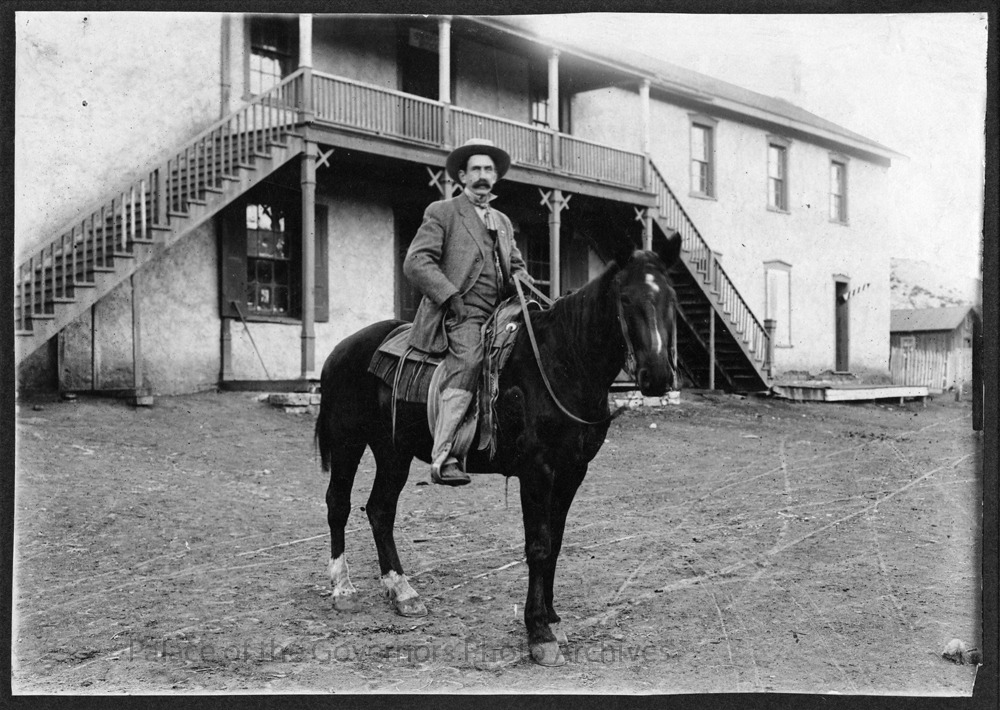
Charles Allison Stevens, Lincoln County Sheriff (1908-1911) in front of courthouse, Lincoln, New Mexico, 1910? Palace of the Governors Photo Archives Neg. No. 089710
Lincoln owes its existence today to an infamous young man who became known as Billy the Kid. But long before Billy and the events of the Lincoln County War, this area was first home to a group of indigenous people called the Mogollon, followed by the Piros and later the Mescalero Apache.
When Spanish-speaking, Native New Mexican settlers from the upper Rio Grande began arriving in the 1850s, they named their new home La Placita del Rio Bonito (the place by the pretty river). In 1869, just four years after the end of the Civil War, the county and town were renamed for the late President, Abraham Lincoln.
In 1873, L.G. Murphy established a store in Lincoln known as "The House" because of its monopoly over commerce in the county. When an enterprising young Englishman named John Tunstall arrived in Lincoln and opened a rival store and a bank, the autocracy of The House was threatened. Additionally, Tunstall, along with his business partners, Attorney Alexander McSween and John Chisum, planned to challenge Murphy's domination of the beef market supplying nearby Indian reservations and forts such as Fort Stanton.
President Rutherford B. Hayes called Lincoln's main street "the most dangerous street in America." In this quiet one-street community visitors can walk in the footsteps of Sheriff Pat Garrett, Billy the Kid, and other infamous characters involved in the Lincoln County War, 1878–1881.
Points of Interest
- Old Lincoln County Courthouse — traces the events as a store, residence, Masonic Lodge, and eventually courthouse and jail.
- Tunstall Store — original 19th century merchandise is on display.
- The Torreon — a defensive tower that continues to stand watch in the middle of town.
- Montano Store — contains exhibits on adobe construction and the Hispanic culture that was prevalent during the Lincoln County War.
- San Juan Mission Church — open to the public and still used for services today.
- Anderson-Freeman Visitors Center — the only non-historical building open to the public; features exhibits on a timeline starting with American Indian pre-history and ending with the Lincoln County War.